Now you can take Mac personalization to a whole other level.
These major changes to CurrentKey try to address how modern workflows are changing.
Now you can take Mac personalization to a whole other level.
These major changes to CurrentKey try to address how modern workflows are changing.
Let’s say you’ve been working hard on a project for the past week, using new apps along the way: you may want to share an overview of your stats for the week…
Now we have “weekly insights” shown as cards in version 8.0+ of CurrentKey Stats. This is a feature based on customer feedback. Users with 3+ weeks of stats will see a new crystal ball button that reveals the insights. You can also share a specific card or a whole week’s worth of cards with your friends, and when you do, check out what it looks like.
This is the only app that I know of that lets you easily share weekly stats summaries. Enjoy! 😉
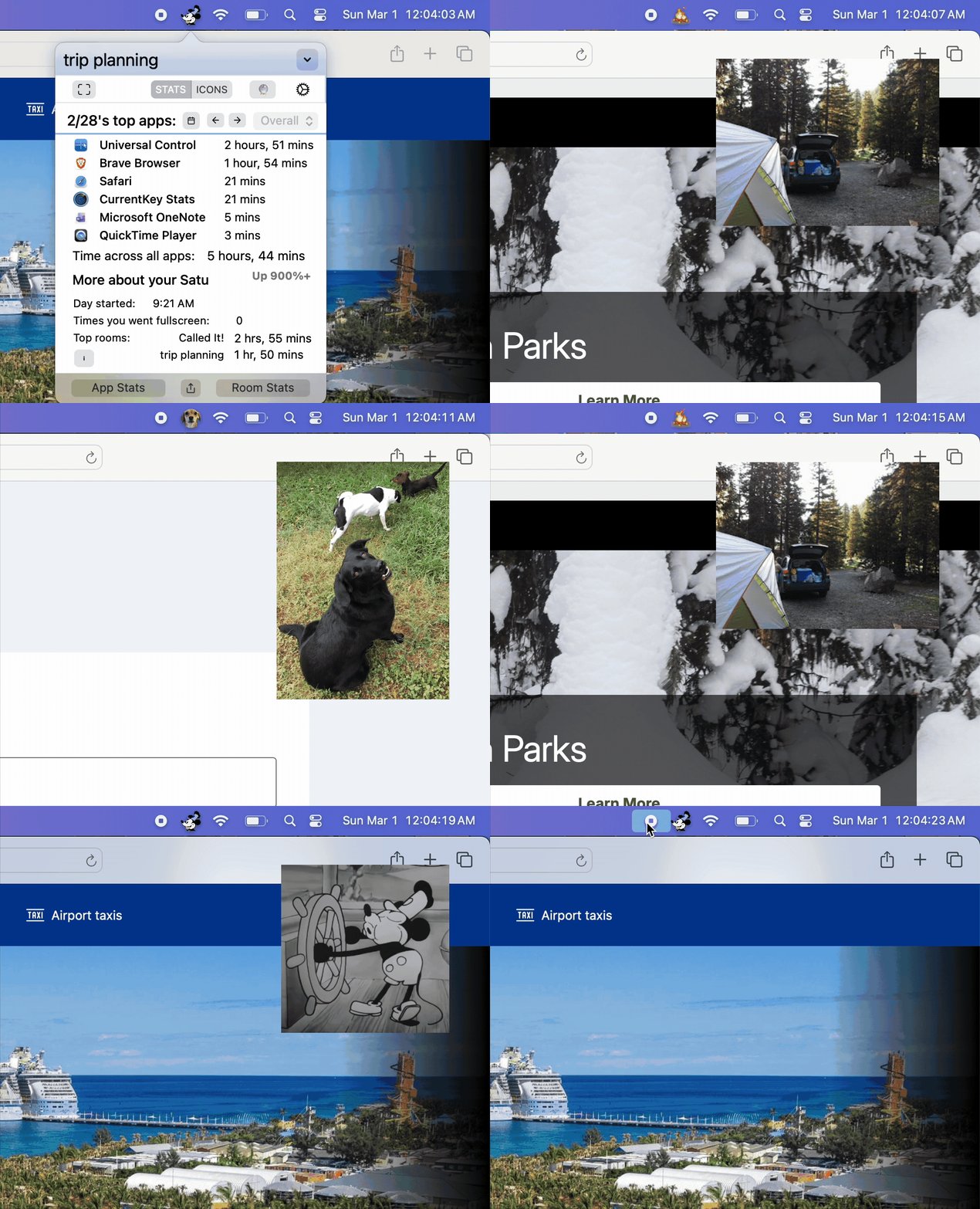
You can tell CurrentKey, via an AppleScript command, to display a custom image in the menu bar for a specific amount of time. This means that you can now have a custom notification/alert icon for anything you can imagine!

“A picture’s worth a thousand words”: in this case it really is true! You now have a novel solution to more elegantly track any kind of incoming info while using your Mac!
Want an alert that you got an email from your mom? A picture of your Mom can appear in your Mac’s menu bar! Got an email from an important client? A picture of their logo can show up in your menu bar! What if you get an email that your website is down? We could show an animated picture of a fire in your menu bar.
Here’s how: Let’s take the “email from your mom” example from above. First, add an image of your momma to CurrentKey’s Script Images. Then create an AppleScript called showMommaIcon.scpt. Finally (if you use Apple’s Mail.app) just create a custom rule for when you get an email from your mom where the resulting action is to run your showMommaIcon.scpt script. That’s it!
Did one of your favorite Shortcuts complete with a satisfying result? Display a happy picture! An unsatisfying result? Show a different one!
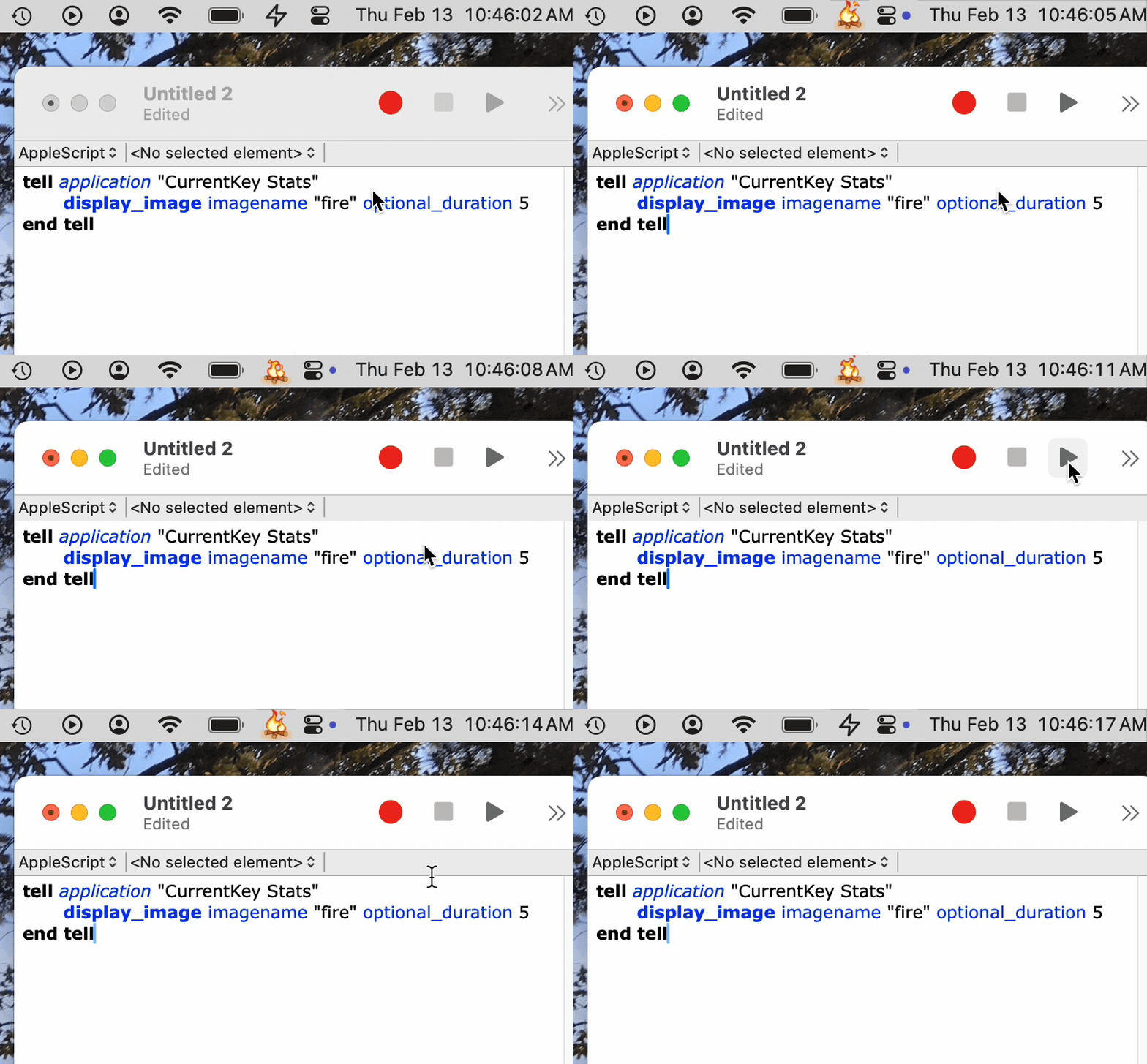
Here’s how: simply add a “Run AppleScript” step to your Shortcut that has a command like:
tell application "CurrentKey Stats" to display_image imagename "happy" optional_duration 5
Where “happy” is the name you gave the Script Image that you added to CurrentKey.
What if you could take any signal and trigger any custom image to show up in your Mac’s menu bar?
With CurrentKey Stats, you totally CAN!
AppleScripts can be run/triggered by other programs — everything from Mail and Shortcuts, as mentioned above, to QuickSilver/Alfred and EventScripts. So you can essentially turn CurrentKey’s menubar icon into a notification/alert icon!
You can use pictures of your kids, pets, company logos, personal art, whatever you want! I personally love buying game asset packs (like here) with some fun animated pixel art and ended up using those. I have also used a picture of Maggie, my family’s doggie. 🐶 [The specific asset pack with the animated campfire that I used above was from this creator.]
Interested in having the picture be animated? I recommend using an “animated PNG” file. (Why does CKS not prefer GIFs? B/c GIFs do not allow transparency, meaning they look like ugly blocks in the menu bar.) To create animated PNGs I used https://ezgif.com/ and clicked the APNG tab and added my sprites (the individual frames of the animation) there 😉 .
Enjoy! – Spencer
PS – I also recently added the ability to assign a custom picture to each Space on your Mac.
PPS – CurrentKey supports over a dozen other AppleScript commands that may interest you.
Update: My favorite Shortcuts guy Matthew Cassinelli wrote an article about this feature, which was really exciting to see!
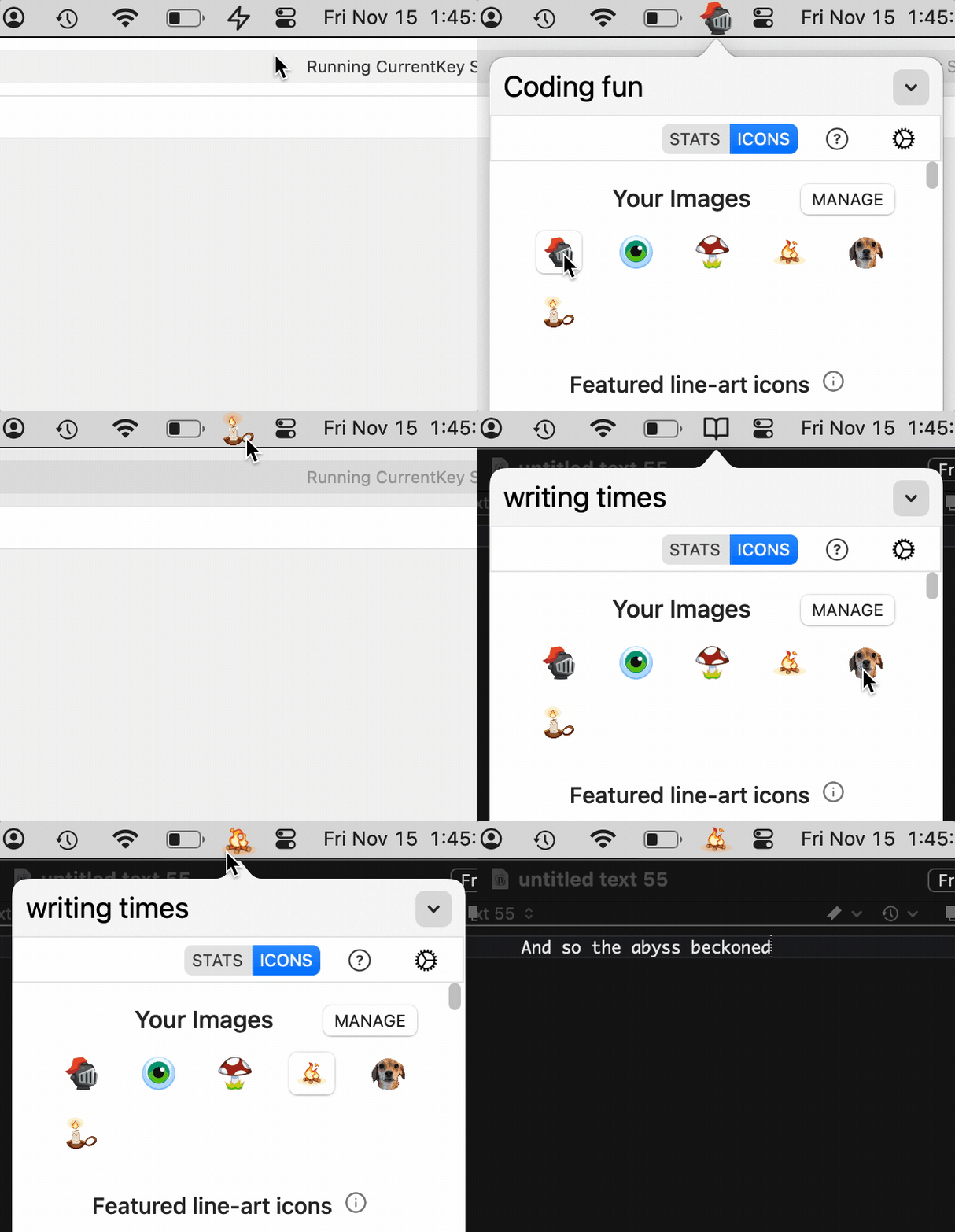
Assign names and now custom images to each of your Mac’s Spaces! These can be PNGs or animated PNGs of any square image you have — pictures of your pets, company logos, family members, you name it! You can also trigger specific images to show up via an Applescript command (which lets you tie any event to an image notification, say your doorbell ringing or message being received (see the “script images” link below).

Thank you for using CurrentKey Stats!
If you have any feedback or questions about anything, please email me.
My hope is that CurrentKey helps you use your Mac more productively and that you can have some fun along the way. Because I have added extensive AppleScript support, there are endless possibilities to spice up your Mac experience.

Just brainstorming off the top of my head, here are some ideas for theme-based Room customization, as well as scripts or individual actions that could make sense to trigger (upon entering/leaving Rooms).
On alerts when you enter a Room: automatically bring a specific app to the front? ✅ take a screenshot? ✅ mute the volume? ✅ toggle macOS dark mode? ✅ activate LED desk lights? ✅ trigger and IFTTT routine? ✅ selectively start/stop a timer based on what Room you are in or App is active? ✅ You can even pass parameters along to a Python script. Here’s a tutorial.
You can also pair Room alerts with CurrentKey’s support for 14 AppleScript commands for even more nuanced outcomes.
A list of specific actions you could selectively combine to create really cool scripts:
First, head to the new Background Services panel, found via Preferences. Next, click the Open button that is next to the “It will look for a user-provided “ck.scpt” in this folder:” label. This will open your Finder to the directory that you will place your custom AppleScript.
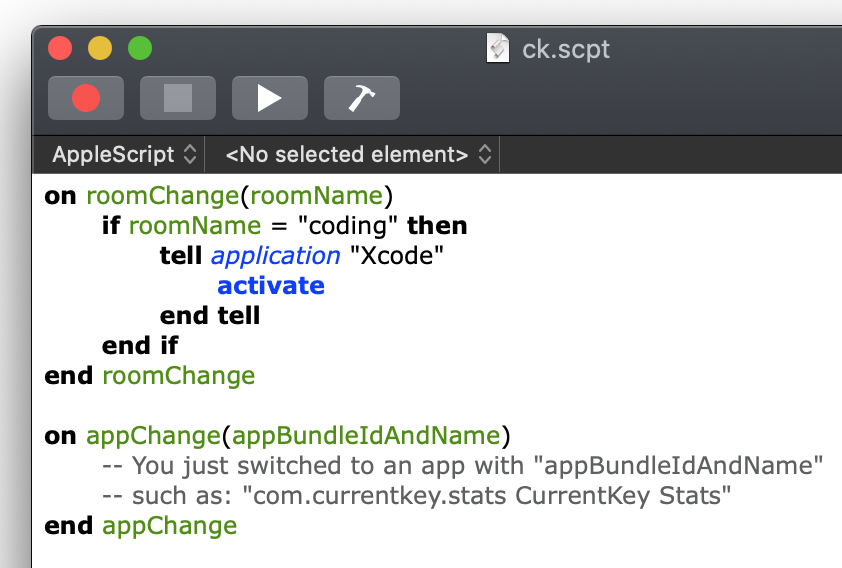
In the example above, the AppleScript will get called with a “roomName” parameter. It checks to see if the Room’s name is “coding”, and if it is, it brings Xcode to the front through AppleScript’s “activate” command. If you move into a fullscreen app, the parameter will read “_fullscreen_”.
This concept is simple and powerful, enabling you to trigger Room-specific functionality outside of the app. Let your imagination run wild with all the possibilities: turn on cool LED lights when you enter your gaming Room? You can write a script for that! Bring your favorite programming app to the foreground when you enter your coding Room? Write a script for that! Pause a timer when you leave a specific Room? It can be done! The possibilities are infinite! There’s a tutorial that includes a video here.
We all know about the MacOS feature called Spaces, and many of us love splitting our projects, work, and hobbies across our virtual desktops.
What if you could not just assign a name to each Space but also assign a custom Internet radio station to each one too? As you move between them, immersive sound would automatically start playing. Thanks to AppleScript support in Broadcasts (by Steve Troughton-Smith), this is possible! (Skip ahead to the video below to see it in action.) Here’s a common use case:
Say you’re studying a second language and arrange your learning materials in a Space you call “Spanish”. I’ll share a script below that…. When you move into your “Spanish” Space, will tell Broadcasts to play a radio station by its name, in this case “Cadena SER España“. Let’s say you want another Space for all things related to your hometown sports team. In my case, this would be the Texas Longhorns. So when I move into “Sports”, we’ll play from the “104.9 The Horn Austin Sports Talk” station. Great! I love programming to electronica, so I’ve set my “coding” Room to play the excellent station “Monstercat“, and – just for kicks – set the OS to Dark Mode.
But there’s just one thing though… What about our other Spaces? In this demo, the script has been written to tell Broadcasts to automatically pause its playback when it goes to any other Room (and turn off Dark Mode).
For more ideas on what could be automatically triggered upon entering/leaving Spaces, check out this blog post! 💡
First, you’re going to need to have Broadcasts. Check it out, and if you like it, grab the full version (it’s currently a $5 in-app purchase).
Next, you’re going to need CurrentKey Stats (App Store link), which is free.
The tutorial video below will show you how to do everything from scratch in under five four minutes!
The steps in the video involve:
That’s it!
For more about the other new features in CurrentKey Stats 3.0, check out the latest blog posts.
The idea had a minor splash on Twitter, and that was fun to see.
Since CurrentKey Stats’ launch, users have often asked for a way to see their Spaces'(Rooms’) names without clicking the menubar icon. The most recent request was just yesterday. The commenter said: “Hi just tried ur app. Its a nice start but if you dont show the name somewhere i won’t be bothered to click on the icon to see in which room i am”.
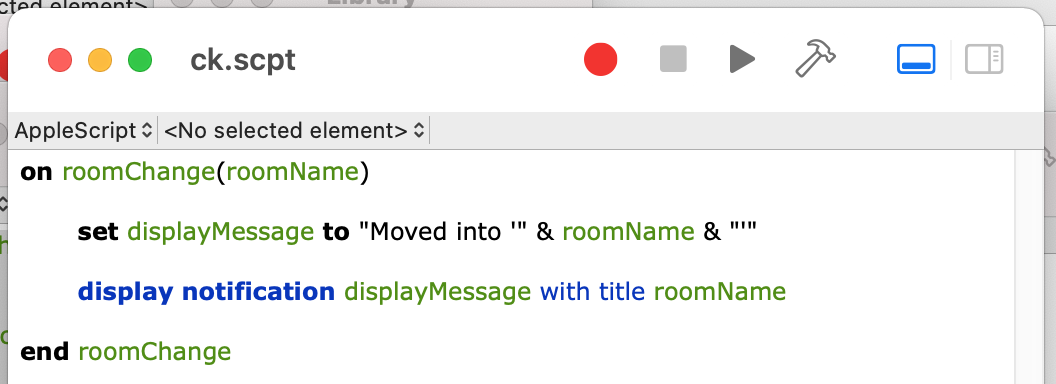
Fortunately, there’s an easy way to accomplish this! We will use CurrentKey’s Room Change Alerts to issue push notifications! Here’s what it will look like:
Here is what the script looks like:

It’s just that easy! You can do so many things with this powerful functionality, even give each of your Spaces a custom sound. More brainstorming fuel is available here.
Most of us know about the MacOS feature called Spaces, and many of us love splitting our projects, work, and hobbies across our virtual desktops. Some find it unweildy because each Space is generic out of the box. Spaces don’t come with the ability to be named or personalized other than setting a desktop background image.
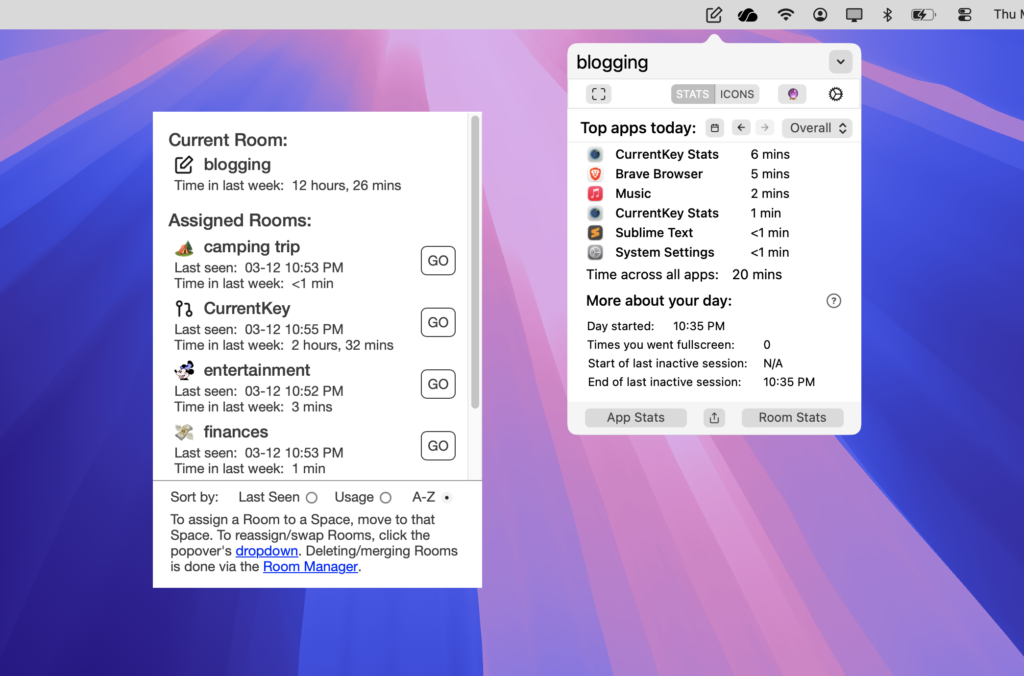
CurrentKey Stats gives you a way to assign names, custom icons, and even custom auto-run scripts to each MacOS Space (the app calls Spaces “Rooms”).

Now CurrentKey Stats recently gained the ability to trigger specific events upon entering/leaving specific Rooms, via the Background Services panel accessed in settings, as well as the ability to respond to AppleScript queries.
Between those two new features, the potential to personalize and automate workflows in Spaces skyrocketed. Want to set a custom internet radio station to each Space? You can do that!
Would you like to hook up your own scripts to CurrentKey’s powerful app stats dataset? You can do that.
Check out the extensive list of brainstormed ideas as to what you could trigger with Room Change alerts – workflows that: automatically bring a specific app to the front? ✅ take a screenshot? ✅ mute the volume? ✅ toggle macOS dark mode? ✅ activate LED desk lights? ✅ trigger and IFTTT routine? ✅ selectively start/stop a timer based on what Room you are in or App is active? ✅ You can even pass parameters along to a Python script. Here’s a tutorial.
Scripts can be aware of when you leave a Room, and can query what the list of active Rooms are. They can also ask a bunch of other questions about stats (like what is your most-used app today, or in a specific Room). Scripts can even request CurrentKey go to a specific Room.
Anyhoo, most people don’t know that it’s possible to create Space-specific automated workflows, and now you do! 😎
For a broader overview of CKStats, check out its homepage, App Store listing, or browse the demo below. Thanks!
[Update: CurrentKey Stats is again being offered in the EU (as of March 1, 2025). I originally had some personal concerns, but I have taken some administrative steps to address them. I’m so happy to get to share CurrentKey with everyone!]
For now, CurrentKey Stats will not be offered in the EU due to the DSA. I’ve received messages and emails from users in the EU asking about why it’s unavailable, and all I can say is: hopefully its a temporary outcome.
Like all indie developers on the App Store (and I guess Play Store), I am faced with a crazy situation. If I want to offer my app in the EU, I must let the store owner (in this case, Apple) post my phone number, email address, and physical address publicly on the App Store listing. Small indie dev shops like mine often don’t have P.O. boxes, so my business address is… personal. All of that contact info will, I assume, be available for bots to scrape. No thanks.
The dilemma is brought to us by a government that ostensibly cares a great deal about privacy – and in many cases, more so than its peers. But not so in this case.
The DSA requires developers who qualify as “Traders” (basically anyone trying to make money, as far as I can tell) to make a declaration as shown below:


Many developers have complained and/or are willfully refusing to comply (by telling Apple they are not a “trader” under DSA).
Many have noted in these forum posts that you can get a PO box, create a new “clean” email address, and get a prepaid phone number to preserve your privacy. Ok? All of that sounds expensive and also like a major hassle. I just want to focus on writing software.
Apple makes it easy to pull your app from stores in EU countries.

But this is tricky if you have a paying customer base in the EU. Fortunately, CurrentKey Stats does not (because its transition to a paid model happened after this DSA requirement was known).
I can imagine ways Apple could follow the spirit of the law, while also protecting and/or assuaging the privacy concerns of developers. Perhaps by simply putting this information behind a button on each App Store listing, which would send a request to Apple for the company to respond to. This simple additional step could help prevent a single user or bot from grabbing thousands of developers’ addresses. Maybe they already plan to implement the listing in this way, who knows? Without clear communication from Apple on this, I have to assume that they will do what they say: post my personal information for all to see.
As this popular reddit post aptly points out: “Screen time for macOS should only count the minutes when the app is open in the foreground” , there’s a basic problem with Screen Time for Mac. Unlike with its iOS counterpart, the stats that it relays to the user are largely useless, because they don’t represent active usage. An even more popular post asserts the same thing.
Reviews of macOS caught on to this fact too, like in Mac Stories, which said: “In Screen Time, every minute Music is open is recorded even if I don’t switch to the app again until the playlist is finished. Screen Time even tracks the Finder, which you can’t quit. That’s accurate if what you’re tracking is your open apps, but it’s not the same thing as how much you’re using each app. … I’d prefer if Screen Time on the Mac recorded only the time spent in the app that has the focus.”
Fortunately, you can address this issue with a free and privacy-respecting app from Apple’s App Store called CurrentKey Stats. It breaks down the time you’ve spent in active apps into a bunch of pretty graphs that include day-by-day and hour-by-hour breakdowns. It also lets you download reports and has other workflow management features too. Enjoy!